Showing posts with label Just Jack. Show all posts

Monday, April 7, 2014

Human Service Agencies: The Road to Nowhere

The desire to help the different, the disabled does not come from sympathy. This desire comes from the medical world, the place where presentation is created by the "artifacts of changing social institutions, organizational formations, and world views" (Bogdan 35); world views taken as real and professional, scientific and central, to deny a group justice, individual agency, or support. The decline of presentations such as the freak show do not involve sympathy; they involve a society's changing motivations. Just as the entitlement of the medical world becomes direct control over the disabled, the feeling of pity justifies the sense of protection we feel from their isolation; instead of naming it eugenics, it becomes the meaningless and unanswerable question of how much a disabled person’s life is worth.

How do the disabled move from a presentation of amusement to one of pity? We can see from Bogdan’s definition that it is created by the way institutions have come and gone. The social construction of the freak has been replaced with the construction of the “poster child” because of the way that the powerful have chosen to shape it; taking all the processes of the 20th century reveal the lack of the disabled’s agency to construct their bodies as their own deviation. It is the idea of condition that resonates with the public and which asserts the possibility of direct adversity in personal lives. The disabled are “meant” to be in a normalized body that disallows them from existing as they are, as unabashed owners of the deviation that constructs the world around them. One cannot understand the origin of this construction if it does not come from a presentation’s role in selling the disabled’s social construction for profit. Bogdan is right in the fact that the shift from the social institution of the freak show to that of human service agencies reflect a change in world views; the way that images are marketed to people accompany this change. As eugenics became a popular concept, the idea of bodily deviation became mapped to the human body by invading the personal space of what our normalized conceptions hold. The idea that bodily deviation can occur still in ourselves, in our children, and amongst people we love created a fear that has a deeply-held desire to be quieted. This construction based on disability allows pity that is so much more far-reaching than the subject depicted, it is insurance for the condition that we may be affected by.

Consider the case of Ryan White:


A poster child for the AIDS movement, his body was the advertising space for how AIDS charities and social service agencies took their profit. The spectacle of Ryan White made AIDS a disease that is not carried exclusively by homosexuals, but by his reception of the disease via blood transfusion, the concept of AIDS changed from a disease targeting a "depraved" subculture to "the general public"; allowing social service agencies to become more and more marketable through the perception of the victim's innocence.

As you can see in this clip: https://www.youtube.com/watch?v=TNWCo-pIyPE,
Ryan White's constant attributes of heroism, social justice, and innocence seems to parallel no other AIDS patient. The human service agencies encourage a plea for Ryan's life rather than a plea for every AIDS victim's life; an ideal presentation of AIDS for profit would not have these other patients exist. There has to be a spokesperson that makes up for the negative connotations associated with AIDS, and while the presentation arguably generates more funding for AIDS-based research, it re-iterates the structural inequalities and lack of resources that will come from polarizing AIDS patients into those with high societal status and those who lack society's normalized values. As in the construction of the freak show, these charities are re-affirming status and re-defining people for the pleasure and "amusement" of the crowd; to get people interested, invested, and involved, for the good of the profiteer. One can see that Ryan White's role as "Aggrandized Status" among AIDS individuals, his comparison with such a "exotic" disease provokes that "irony" that makes him even more of an oddity and a greater character of dehumanization. The ownership of his life is stripped away, as evidenced by this People Magazine Cover giving away the last days of his life, as if they were a commodity rather than an indication of the suffering death by arespiratory infection can cause. 

In order to understand the disabled, as Robert Bogdan says, we must "get behind the scenes" and see the world from the "other's" point of view. We cannot choose to look through the presentation that these agencies give us, they are not only marketed, but tailored to the values that patriarchal institutional structures leave behind. Just as the freak show of the past century becomes synonymous with old-world injustice, we must evaluate the modern era for the possibility of both changing and subversive world views that exist in modern social constructions. It is not enough to establish the human service agencies as the "new" freak show; in order to uproot definitions made through the hands of the powerful, we must understand the presentation as constructing fantasy. If we seek to give power, agency, and individualism to the disabled themselves, we have to allow them the ownership of their own lives.


Bibliography:

Bogdan, Robert. Freakery: Cultural Spectacles of the Extraordinary Body. Chicago: University of Chicago, 1988. Print.
"Ryan White Official Site." Ryan White Official Site. N.p., n.d. Web. 08 Apr. 2014.

Tuesday, February 11, 2014

Violence in the Borderlands: An Analysis of 90s Talk Shows & the Media


The tendency to place constructed definitions of self-expression onto an echelon of social hierarchy is nothing new; the hull of the American academy of Women’s Studies is dedicated to seeking out implications of the term “woman” and “man” in both an American and Global sense. This labeling does more than provide an accessible definition of social groups for the society that it surrounds itself with; it is “entrapment” to the persons whose values seem to be faded out by the defined social group they are placed in. I am not only talking about the personality, the biology that is assumed to explain who a person is; I am talking about a lifestyle, the fact that there are people who exist on the borders of these definitions that struggle to find their place in residences, in careers when we map these people based on their occupation and define them when presented with representations of their bodies in the media. Never is there a group of people that are more captivated by public fascination than those that are found outside all of our definitions; and the need to label them becomes a hope to resolve inner conflict when “the other’s” existence challenges the advantages that were supposed to be intrinsic and essential to the people that affirm the gender system.

Gender Outlaw brings insight into the oppression of the border-dwellers of gender when Bornstein refers to the gender defenders, the gender terrorists who hold the borderless hostage in upholding the social construction of gender (Bornstein 71-72). The terrorists fight, willingly or unwillingly, for the maintenance of roles based on sex and defined by gender; naturally fluid personalities become more rigid in adherence to the societal attributions placed onto the terms “man” or “woman”. It is not enough to say that these people only influence those who consider themselves transgendered because they influence people who are residing comfortably in a defined gender construction to be their ally; to trust in and inhabit invisible privilege with the promise of perceived advantage that is intrinsic to themselves and disconnected from the oppressed. The reason why the gender defenders tend to classify these people, Bornstein argues, is to silence them; to make them isolated and then invisible by rationalizing psychological as well as situational pseudo-theories about them. These theories stem from the gender terrorists as pilots in the media, encouraging observation rather than direct contact with the gender-ambiguous or the gender-less. These border-dwellers are not given the benefit of the first impression because deep down there is insecurity by these same gender defenders that the gender system might be figured out; there is a fear that it would only take direct contact with the border-dweller to spark the flash of knowledge that degrades hierarchies. As Bornstein writes “something happens, some final bit that lights up the injustice of the gender system, and in that flash, we see that the emperor is wearing no clothes”, the flash enables the normative group to question the essence of themselves when the only thing that has been consistent in their lives is the precedent to act in their prescribed gender (Bornstein 85). If the injustice and inconsistencies of the gender system are revealed to us, the oppression that we see culminating in the transgendered finally becomes real to us; it is something that has been stuck in the bones of the oppressed so long it is real enough to feel and transform them. The gender defenders choose not to engage with the transgendered not so much because of this fear in their existence, but it is moreover a fear of the wounds they will turn up when they lend a hand to help the oppressed out of their hole of existence.


In researching the labels that transgendered people are placed into, I came across the common theme of sex work occupations being associated with the bodies of male-to-female transsexuals. The intense fetishism with which society associates the concept of ambiguous women manifests itself in the talk show, where therein can be found a supplication for the general public’s beliefs to be re-affirmed rather than answered from well-intentioned curiosity. In these talk shows I realize there is no consideration given to the transsexual subject; frankly it does not matter what the transsexual’s dialogue concerns because the panel of transsexuals has been constructed to reflect more of this certain lifestyle than the distinct personalities of the subjects themselves. Their image is everything they are to the audience; it is why they are made to wear “street clothes” and picked based on their irreconcilable similarities to the gender they are assumed by the audience to inhibit. The members of the panel are embarrassed endlessly when talk show hosts such as Jenny Jones reminds the audience time and time again, “I feel like I’m talking to real women,” the comments of the interviewer and the audience expose just how strongly gender is taken for granted. The funny thing is that the façade of titles such as “Anti-Trans Violence” provide a source of justification for the audience; the gender defenders are seen as helping these people overcome statistically correlated problems by the public when really these shows are just re-defining them to Americans whose curiosity with the borderless hasn’t been stymied. A Donahue show that aired in 1991 juxtaposed the recent event of Danny Bonaduce assaulting a transgendered prostitute with a panel of New York City transsexual call girls, the transgendered prostitute who was assaulted taking abuse from the transsexual call girls for reporting the crime. To them as well as the audience there was an underlying belief in deception as the accelerant for the event; that transgendered people are held to the harsher standard of guilty until proven innocent even when they are victims of the crime. What Kate Bornstein want us to take home with us, what I think she holds as her purpose in the creation of Gender Outlaw is centered in the fact that displayed notions of the borderless are not necessarily true for the character of the individual. Media representations delude our view by being so inaccurate, and the only reason they are allowed to carry on is simply because their message is one that has been for so long part of the status quo. Male-to-female transsexuals are not by definition prostitutes or call girls; they are real persons who deserve the privilege of being met as who they are. Media bias is violent and the culture it perpetrates is in every respect undeserved by the borderless it affects. In order to truly expel violence and negative implications of the borderless we must actively fight the gender terrorists and the gender defenders; we must let them know that their actions are not only unacceptable, but destructive in creating a safe environment for all of us to exist.

These are the Links to the Talk Shows I viewed!


Works Cited
1.      1. "Anti-Trans Violence." The Phil Donahue Show. CBS. WLWD, New York City, New York, May 1991. YouTube. YouTube, 04 Feb. 2013. Web. 11 Feb. 2014.
2.       2. Bornstein, Kate. "Gender Terror, Gender Rage." Gender Outlaw. S.l.: Vintage, 1994. 71-85. Print.
3.       3. "Transsexual Call Girls." The Jenny Jones Show. CBS. New York City, New York, n.d. YouTube. YouTube, 25 Nov. 2012. Web. 11 Feb. 2014. 


Tuesday, February 4, 2014

Essentialisms within Religious Institutions

The definition of what makes a person human, that is, the characteristics that make someone real enough to be valued as significant, are laid out for us in Bodies in Doubt.  It tells us a story of sex and sexuality, one that on a more profound level represents one of gender and one of oppression. Bodies in Doubt is a history of the struggle of the non-gendered; of “the other” when it comes to the sexual binary of male and female, the genital binary of penis and vagina, as well as the division of the penetrator and the penetrative. What American medical professionals of the 18th, 19th, and 20th century view as the requirements of being considered human goes far beyond features of the anatomical body; it has to be the absolute trust and knowledge of the “essence” one is born into, dictated by medical professionals at birth and in one’s development so that one can avoid “perversity”, “immorality”, and even suffering. Essentialisms are the pre-destined fate concerning what personality you must take on; it assumes the rules of the gender binary (what it means to be defined either as “woman” or “man” in American society) as well as the sexual binary (who you are supposed to have sexual relations with based on gender expression and more importantly, genital appearance). In American society, we are defined by our genitalia in this view; it must be clear and unambiguous to one of two sexes so that our essentialisms can be read by other people and known by us. It allows others to guess at who we really are and come up with the methods for how our social position should affect us.

A Medical Anatomical Chart of Intersex Individuals -- 19th Century


The separate categories of “hermaphrodite” and “pseudo-hermaphrodite” created by 19th century doctors allows for the denial of essentialisms that involve anything other than one attribution of male or female. Hermaphrodite, an archaic term that has been replaced by the more modern intersex, is defined in the present day as being born with sexual anatomies that a society considers non-standard (Rubin); it seeks to take the notion of medical illness out of a quality of being. The two categories of the 19th century definition classify persons with “ambiguous” genitalia (genitalia that did not represent to medical professionals one clearly defined gender) with the expressed purpose of trying to show hermaphroditism as more of a pathology;  a treatable condition that is forced to rely on a body’s “essential” gender. True hermaphrodites are those identified by medical professionals to be able to beget and conceive; a perfect fusing of the distinctly male and the distinctly female when sex is purely observed from the function of child-bearing. These persons, which doctors made clear are at best dubious in existence, is the only argument these professionals give for why they chose to classify persons based on a group that have not been encountered and “the others”. Pseudo-hermaphrodites, which medical professionals frequently apply to the patients that they encounter, were “truly males who resembled females or truly females who resembled males” (Bodies 59).Unlike the true hermaphrodites, the pseudo-hermaphrodites did not have a legitimate reason to stay hermaphrodites; their “condition” was easier to justify as a disorder and their essence to one sex was something that existed. Medical professionals in this context did not fear the cases of the pseudo-hermaphrodites, it would be the existence of the true hermaphrodite that a major need for the separation of genders, for the separation of sex in reference to child-bearing could be put into question.  With true hermaphrodites the whole essentialist argument goes up into flames; medical reason could not dictate the sex a person is “meant to be” due to the fact that clearly defined sexes no longer have biological functions that are seen as necessary or for that matter, full of the purpose that the definite separation of sexes guaranteed.


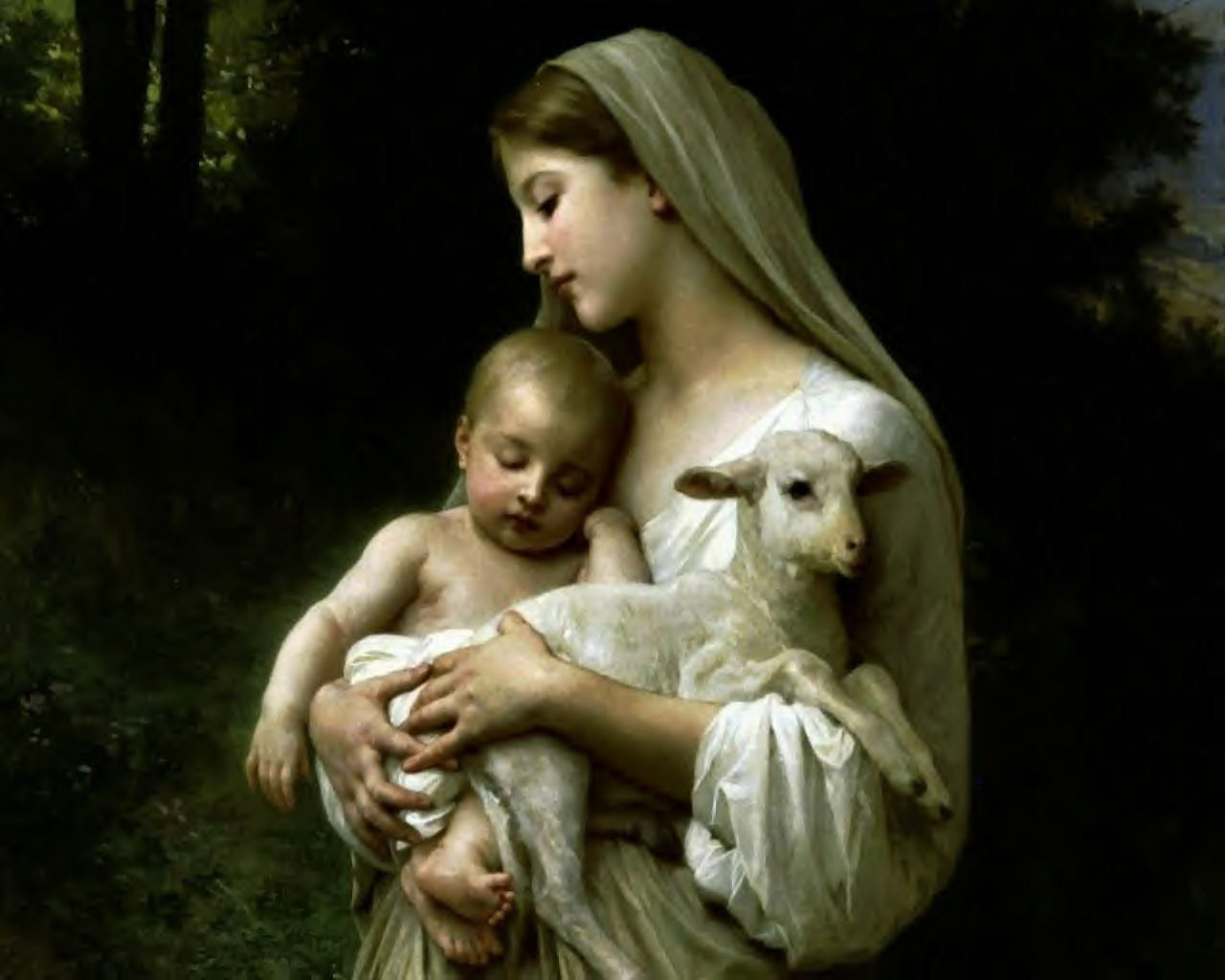
The Virgin Mary and her son

In the present, these same notions of essentialism that demarcate sex as well as gender are as mundane as our current American culture. It is something kept alive by institutions that have been founded on such essentialisms, one of the most pervasive being the Catholic Church, whose influence on American culture is unquestionable in the education they provide for youth as well as through the services they hold for the vulnerable and the powerful alike. I have been educated as a student within the Catholic faith, and I see the emphasis on personal essentialisms gifted by a God as something that is enacted out of insecurity within the church’s foundation; the fact of the matter is that the negation of these essentialisms destroys the church’s history and thus its legitimacy. In a speech given by the Catholic Church’s previous Pope, Pope Benedict XVI, there was a need to emphasize the fact that “transgender people were destroying their very essence”, that is they were “destroying their God-given gender to suit their sexual choices”(Ratzinger). The language Benedict uses here is key; the fact that he says the words “God-given gender” assumes that all people are born with a gender (which, by the way, is not changed to suit sexual preference) and that they keep it for the rest of their lives because it is a part of their “essence”. This essentialist theology is the only thing we can hope to know about the Catholic Church’s position on intersex people, as still today intersex people are not recognized as extant by the church; meaning there are no documents/resources that could possibly try to guide an intersex person within Catholicism. The reason why intersex people don’t exist within the church relates to the reason why the existence of the “true hermaphrodite” by medical professionals is often denied; the Catholic Church operates this avoidance out of fear of losing its legitimacy. If the church did in fact affirm intersex people’s existence, there is one central figure within the Church’s theology that would be called into question: the Virgin Mary, whose claim to giving birth to the only baby while still remaining a virgin could be called into question. If a true hermaphrodite has existed at some point throughout history, wouldn’t this contradict the church’s claim? Or even better, is the fact that the Virgin Mary gave birth without sex evidence of her intersexuality, her existence as a “true hermaphrodite” that has been worshiped for ages?


These were two links I found interesting:


Bibliography

Histoire Naturelle Hermaphrodites. Digital image. N.p., n.d. Web. 04 Feb. 2014.

Ratzinger, Joseph. "Address by the Holy Father on the Occasion of Christmas Greetings to the Roman Curia." Speech. Christmas Greetings to the Roman Curia. Clementine Hall, Rome. 3 Feb. 2014. Address by the Holy Father on the Occasion of Christmas Greetings to the Roman Curia. Web. 04 Feb. 2014.

Reis, Elizabeth. Bodies in Doubt: An American History of Intersex. Baltimore: Johns Hopkins UP, 2009. Print.

Rubin, David. "Intersex: Before and After Gender." Diss. Emory University, 2010. Emory ETDs :. Web. 04 Feb. 2014.

Virgin Mary. Digital image. N.p., n.d. Web. 04 Feb. 2014